Translate Blog

Saturday, 11 April 2020

Replacement seat covers - front drivers seat

The front seats are very similar to each other. The frames, padding and covers are identical, only the backrest adjustment knobs were fitted on opposite sides (facing out). On the Pallas there is an additional height/rake adjustment for the drivers seat, this can be compared to a standard frame courtesy of the 648 replacement parts catalogue shown below.

Standard front seat frame (left) and Pallas seat frame with height adjustment (right)

Removal of the seat couldn't be easier. Wind up the backrest all the way (this will assist in removal through the door aperture later) Slide the seat nearly to the most forward position and remove the two M7 bolts at the rear of the seat runners then slide the seat back until you can access the two front bolts, these only need to be slackened off sufficiently as the frame is slotted here (the slots can be seen in the above 648 replacement parts catalogue) The seat can now be removed and placed on your best dining room table to be worked on.

I seem to remember in the 1970's fluffy tan sheepskin seat covers were all the rage, however, I knew these were hiding something more sinister as I'd already had a peek and it wasn't pretty.

Front drivers seat removed
Lifted the front corner to have a peek
Not pretty!
On the back of the seat the lower half has a closing panel trimmed with light grey leatherette material and also houses the ashtray. The material was in quite good condition apart from a small scuff, fortunately a piece of this material comes with the new seat covers and is easily replaced.

Back of front seat showing the closing panel
Under the front seat showing good framework and springs
So the first job is to remove the closing panel which is held in place by four pozidrive screws at the sides and hog rings underneath the seat frame, there is no need to remove the ashtray at this moment. There is a reinforcing clip on the closing panel which hooks under the back of the seat frame to stop the closing panel from distorting when you open the ashtray.

Screws securing side of closing panel
Hog rings securing trim under seat frame
Removal of the closing panel trim revealed more labels as shown in my previous post, the markings on this label make it more apparent the trim is made for a Pallas (PA) trimmed vehicle.

Label identifying Pallas trim
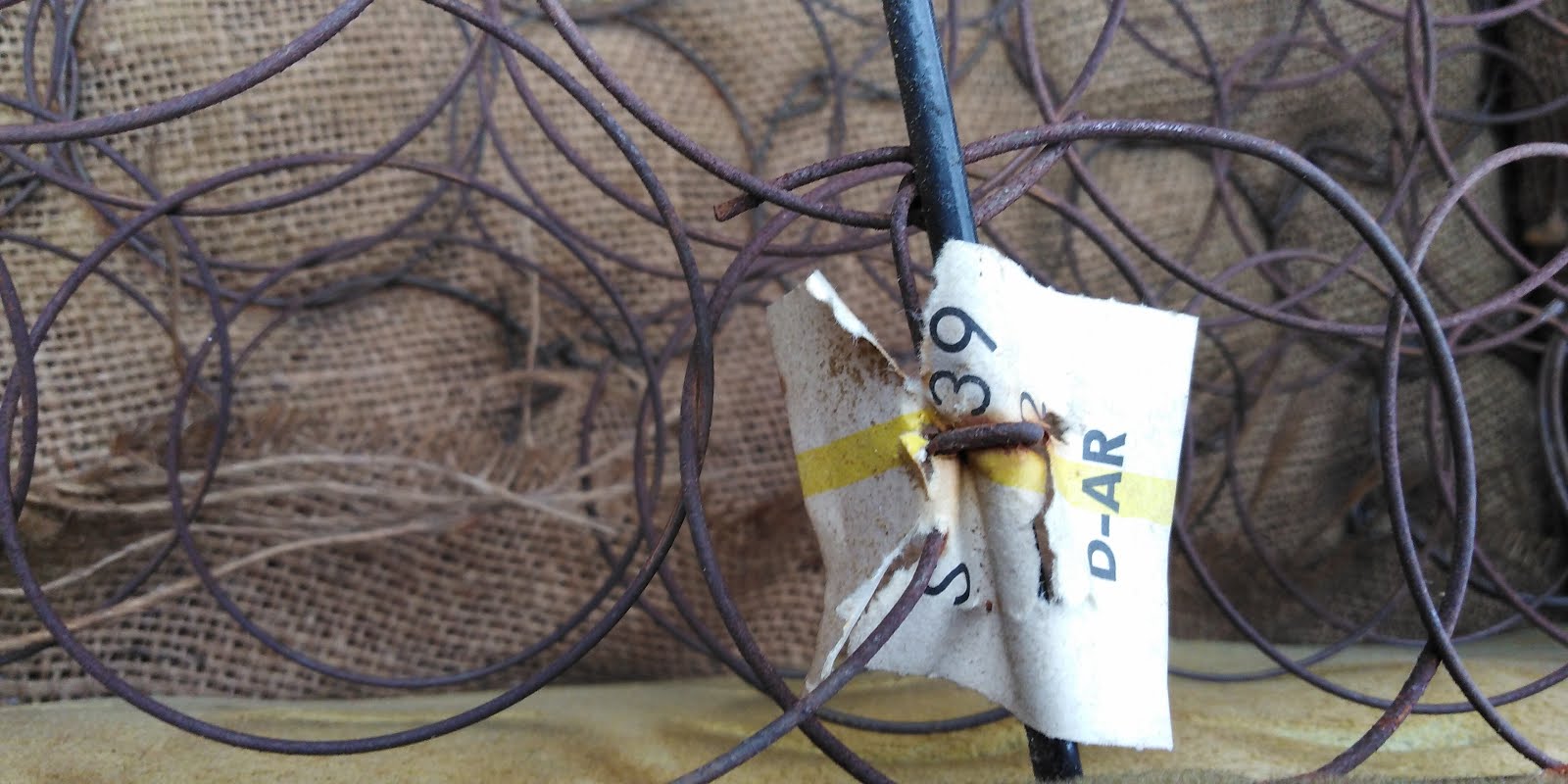
Another label under the seat frame (not sure what'202' or 'cav' signifies)
The 1970's fluffy tan sheepskin seat covers kept the chrome in good condition
With the closing panel removed you can see that the seats are not 'handed' and can be used on the left or right with cut-outs for the ashtray available on either side

Access for the ashtray (in this case on the right hand side)
A hair clip and the back of an earring fell out of the seat frame - If these could talk!
Continuing with the disassembly - remove the hog rings in the corner of the backrest, this will reveal two M7 bolts on either side of the frame. Remove these bolts and the seat frame will separate into two halves making re-trimming a much easier job.

Remove hog rings in corner of backrest
Tensioning wire can be left secure until later
Bolts securing the two halves 
Seat halves separated
Removal of the seat covers are now quite straightforward, I started off with the cushion as it looked the easier option. As shown above there is a tensioning wire which runs around the circumference of the cover and secured in the corners. There are several hog rings along the sides and metal tangs in the front corners, remove these and the cover slips off. After a good clean of the seat foam I loosely fitted the seat cover. I used Bulldog clips before I permanently secured it with hog rings so I could check the finished look and make any adjustments. Happy with the fit I secured everything in place.

Bulldog clips in place to check the final look
Hog rings permanently secure sides of seat cover
The cushion is now complete ready to receive the backrest.


The backrest is the same procedure as the cushion. Removal of the cover is simply done by removing hog rings from the perimeter, glue is used down the front sides to keep the concave shape.

Removing hog rings from inside perimeter of seat cover
Here you can see where the foam was originally glued
With the cover removed you can now see where the front headrests locate. Headrests were an "accessoire" even on the Pallas spec. On models produced after December 1972 the size was reduced from the full width headrest to a narrower version as can be seen below.

Holes in top of seat foam to accept headrest guide tubes
Guide tubes locate into top of seat frame
I first had a trial fit of the seat cover before I started spraying any glue on it, when I was happy with the shape and fit I used a heavy duty spray adhesive on both the cover and foam and allowed it to go off for a few minutes. When it had gone tacky the cover was held in place and allowed to fully dry.

On the original seat cover there was a reinforcing seam on the edge where the hog rings went through, the new seat covers didn't have this, instead the edge of the material was rolled over on itself to form a tube. So the hog rings do not pull on the material directly I fed a length of electrical cable through the tube to give them something substantial to grip onto.

Original cover with reinforcing seam
Feeding cable through tube at edge of cover
Hog rings secured around cable inside cover
The remainder of the seat cover can now be secured after the fit has been checked first with the use of Bulldog clips.
Checking the fit before finally securing with hog rings
The back corners are left open to allow access for securing the two halves of the seat frame together, I used a little drop of Loctite on these M7 bolts.

Securing bolts left side
Securing bolts right side
After the seat halves have been secured together the final corner pieces can be held in place with hog rings.

The rear closing panel trim is a straightforward replacement using glue along the edges.

Inside of rear closing panel
Outside of rear closing panel
Close-up of ashtray aperture showing reinforcing clip
Ashtray polished up brightly
Closing panel secured under seat frame with hog rings
Ashtray back in place
A quick once over with steam from the iron removed any creases. Please see caveat from previous post. 

Refitting the seat back into the car is, as they say, "is the reverse of removal" Leave the front two bolts in place loose as these slot into the runners. Tighten the back two bolts first then the front two.

And relax...


Wednesday, 13 November 2019

Replacement seat covers - rear backrest

The rear seat backrest in trimmed in 3 sections on a common frame - left, right and center armrest. This is very convenient with the Jersey rayé material as it allows for any deviation in the striped pattern to be adjusted to match the rear cushion, it also allows you to strip down and retrim one side at a time using the other side as a reference. The center armrest is secured on a folding assembly secured to the main framework by 2 countersunk screws and 2 plain screws with washers. The plain screws were found loose on disassembly - more on this later. After removing the screws a flap of material is secured by barbed tangs folded over a rod which is fed through a sleeve in the material. Folding back the tangs allows you to release the trim and remove the armrest.

Center armrest assembly secured to main framework
Deterioration of the hessian can be seen here
Damaged trim on the right hand side
Damaged trim on the left hand side
Close-up of the center armrest securing screws
The next 3 images show some labels which have been left in place for originality, I've not done any research on these but must have been used at the factory for production purposes.


Center armrest removed
Material removed from around top of backrest and the foam padding has vanished
The center armrest is basically a foam topped wooden frame which is secured to the metal assembly by 4 screws and nuts, removing these allows removal of the trim material which was secured by staples.

Removal of the armrest wooden frame
Unpicking staples out of the wood
More staples
Started working on the right hand side for no reason. More barbed tangs secure the top of the seat cover, bending the tangs back allow you to release the top of the cover. The rest of the cover is secured by hog rings onto the metal framework, remove the hog rings and the cover slips off. As with the seat cushion previously, the foam on the backrest had shrunk down in size and needed additional foam padding glueing in place to pad it out more, I used 1 inch on the backrests and ½ inch on the sides. Fitting the new cover I started at the top as the position of the material is 'fixed'. A dry fit in the car then allows you to align the bottom of the new backrest cover to the new cushion cover, once the pattern meets up it can be secured by hog rings. Repeat for the left hand side and the center armrest can be refitted.

Extra foam padding for the right hand side
Top of seat cover secured by tangs on the framework
Extra foam padding for the left hand side
Inevitably there was a crease on the left hand side seat cover which did not disappear as I hoped it would when fitted. Fortunately I watch far too much daytime TV on car restoration. The solution is steam, applying steam to nylon allows it to be shrunk and smoothed by hand back to the normal shape. Using a steam iron allows you to direct a blast of steam onto the crease and it really does vanish before your eyes.
Caveat: Please consider the risks of using a hot Iron near nylon material you could soon end up with an expensive melted mess, I held the iron about 2-3 inches away from the material.

Visible crease in seat cover from being folded in a cardboard box
The power of steam - there is no app for this!
Looks even better now after a few days in the car
Back to those loose screws on the center armrest. On the back of the backrest there is a thin board to hide the frame and springs etc from being visible when opening the boot lid. Mine was completely missing, probably suffered from damp and fell off. It was originally secured just by those two loose screws in the middle and the rest of it was just sandwiched between the outer part of the seat frame and the bulkhead. Woolies trim supply millboard for such use and can be cut with a knife or tin snips, trial and error determined the size of the finished board, I secured the corners with some tie wraps just to stop the millboard from flapping around when trying to put it back in the car - these won't be visible from inside the boot.

Millboard backing finishing the the backrest framework

Replacement seat covers - rear cushion

The rear seat cushion was the obvious starting point to me for two reasons, the cushion is easily removed by lifting up from the front corners and releasing two nylon inserts which locate into a recess in the sill, and secondly the replacement cover is one piece that fits over the base padding and clips onto a wire frame with hog rings.

Here you can see the nylon inserts that secure the base
The simplicity of this eases me into something a little more complicated later on, having not done any re-upholstering on older vehicles with the use of hog rings.

The cover folds over the frame and secured with hog rings
First of all the rear cushion was removed as described above and worked on outside as there was a lot of mess with deteriorated sponge and rotten nylon. Once removed the seat base padding was in quite good condition. The base just sits in a wire frame that had a little surface rust I wire brushed the frame a gave a couple of coats of black paint.

Originally there was evidence of the base being secured temporarily in place with tape before the cover was fitted, so I did the same.

Working inside now with the wire frame painted and seat base in place
Easing the seat cover over the padding and framework then tucking in the edges under the frame gives you a good indication of the final fit. I found that there was a small area in the front corners that was left a little bit baggy no matter how much I pulled the cover tight. I presumed that the base had shrunk or deformed slightly over the years.

To overcome this I purchased a piece of ½ inch upholstery foam and cut out two pieces to shape and glued them into place to pad out the original foam. Now with the cover fitting nicely it was secured permanently with hog rings about every 2 inches along the frame. And that was it finished ready to back in the car.

Rear seat cushion finished stored in the spare bedroom for now
A reminder what the original looked like
Next...the rear seat backrest.

Tuesday, 12 November 2019

Replacement seat covers - preamble

In France this year was "Rassemblement du Siècle" or the Rally of the Century. Between July 19th and 21st at La Ferté Vidame, Perche saw 60,000 visitors and 10,000 vehicles including 4,200 Citroën models and numerous trade stands.

Amongst these trade stands was the ever helpful and talented Toon and Richard Langelaar from Citro-Classique  If you are going to buy any carpets or seat covers for your DS, these are the people to go to, the quality and attention to detail is flawless and at a reasonable price.

I sent Richard an email to save me a full set of seat covers in Caramel Jersey Velours rayé for the 1973 model year Pallas, he duly obliged then relieved me of €550 - worth every penny!

The "Jersey rayé" or striped Jersey trim was only available between 1970 and 1973 models after that it was superseded by "Jersey carré" or square Jersey trim on the 1974 & 1975 models years.

Nylon and foam after 46 years of sunlight and damp takes its toll, the nylon disintegrates and the foam turns to dust, the only solution is to remove the seats, strip them down and replace the seat upholstery and the foam padding/wadding.

The only special tools required for this job are hog ring pliers. Hog rings are like big staples, used to attach the upholstery to the foam and frame, the pliers are readily available and I bought mine through Amazon for £30.00 with 1,000 hog rings.

I started with the rear seat cushion as this was easily removed and looked more of a straight forward job, some of the deterioration can be seen below.

The foam padding can be seen here which has turned to dust
Hessian fabric was also used on the upholstery but was very fragile and threadbare
The nylon on the seat cover has deteriorated and vanished

Thursday, 6 September 2018

O/S/R Wing repairs

On my last post about the repairs on the O/S/R wing I mentioned how it was secured at the back with a single bolt for ease of removal. Obviously it is important that this bolt is secured firmly and that the wing is in good condition. The later was not the case on mine and could have had disastrous consequences. The section of wing surrounding the boss had fractured approximately 50% of the circumference and copious amounts of paint and underseal was disguising the fact.

Outside of the fracture which was covered with paint

Inside of the fracture after underseal was cleared away
I think the way forward on this repair will be to braze as the existing metalwork is quite thin. This will add plenty of material and is more forgiving.

Monday, 13 August 2018

O/S/R Wing repairs

The rear wings on the DS saloons are easily removed with one bolt at the rear, which is the same 19mm socket size as the wheel nuts, and secured at the front by two pegs that locate into rubber mounts in the wing closing panel. The reason behind the simplicity is obvious to DS owners who have ever removed a rear wheel as the wing has to be removed first. Even in the high suspension position there is insufficient clearance to remove the wheel with the wing in place.

O/S/R wing showing securing bolt (the big hole is for the rear reflector)
The closing panel with its seal that sits against the c-post was a trap for road dirt and moisture and hence severe corrosion was inevitable due to the lack of modern rust proofing techniques.

Fortunately replacement rear wings are available from the clever Dutch people, however, they are quite expensive. Alternatively, there are repair panels made for the common corrosions areas,  providing the rest of the wing is in sound condition this is a viable solution.

On the Pallas models additional trims and door rubbing strips were fitted, which looked nice, but created water traps and surface corrosion which now needs treating.

The next 5 photos show the extent of the corrosion and bad previous repairs.

Corrosion around inside lower mount near support brace

Corrosion around inside top mount

Corrosion around outside top mount
The photo below shows the location of the rubber seal that sits against the c-post and the tabs that secure the seal between the wing and rear door, both seals have long gone but replacements are available.

Corrosion around outside lower mount

Corrosion around inside support brace
After carefully measuring the original dimensions of the wing, cutting out the corroded areas can begin, this has been scribed to the repair panel which will be joggled underneath the cut. The next photos show the original dimensions and you can also see the surface corrosion caused by water being trapped in the trims and rubbing strips.

Bottom dimension

Top dimension
After a rough cut close to the scribe line with air shears I finished off with hand held tin snips, I find these more accurate and leave a better cut without distorting the metal. Care also has to be taken around where the support brace is welded in place.

Top of rear wing cut away

Bottom of rear wing cut away

Inside of rear wing cutaway avoiding support brace
After cutting back to good metal the paint and underseal is removed and the repair panel is offered up for a trial fit. Keeping to the original dimensions the panel is clamped in place and secured with Cleco fasteners.

Bottom of repair panel in palce

Top of repair panel

Location of support brace which will be plug welded to the repair panel
Cleco fasteners allow a temporary but secure solution to join two pieces of sheet metal together. They allow a trial fit and make any fine adjustments before being permanently welded in place.

Rear wing in place to check the fit and shut line against the rear door

Here you can see the plastic pegs on the c-post supporting the front of the wing
That's all for now, next step is to weld the panel in place... updates to follow.

Saturday, 21 July 2018

New arrival

I met a few people at the Citroën Car Club National meeting this month at Abbots Ripton who were enquiring about the progress of my restoration. Along with blog followers noticing that my last post was November last year I thought I would offer an explanation. Well, work is still continuing on the nearside door bottoms the rear door now wanting a complete door skin. Progress has slowed down due to Christmas and Summer holidays, but the main reason is my Daughter, Lindsey, gave birth to our first Granddaughter, Harlow, in January.

Restoration blogs will be resumed to normal soon. In the meantime i am trying to book accomodation in La Ferté-Vidame, in Perche area, in France for the Citroen centenary celebrations in 2019... I fear I may have left it too late?

Harlow and I just chilling :)